Monday, June 13, 2011

Pictures of Paradise

June 2nd and 3rd, 2011
Framingham, Massachusetts


Painters are wont, in their pictures of Paradise,
to strew the ground too thickly with flowers.
There should be moderation in all things.
Though we love flowers,
we do not want them so thick under our feet
that we cannot walk without treading on them.


HDT Journal, June 15, 1853

Thoreau would have had a hard time of it, then, at the Garden in the Woods, which is just a short distance from Walden. It’s a fantastic place for anyone remotely interested in native plants, and it’s chock full of botanical wonders.

I had never been there, and it was my great fortune to be invited on this field trip by Jackie and several of the Thursday Naturalists.

We all ended up staying at the B&B in Lincoln, where I usually stay when visiting Walden. Ed, Ruth and Nan would be staying only one night, but Jackie and I stayed a little longer. All were charmed by the house and by our host Barbara, who makes everyone feel right at home.


We spent the better part of 2 days at the Garden, and did not get to all the trails. Plants are labeled (huzzah!) and arranged by habitat. There were guided tours available, but I had the best guides possible in my knowledgeable companions.

To say we were like kids in a candy store, is an understatement!


The first stop was to the Rare Plants section. Since I am relatively new at this, I don’t know enough to even know if a plant is rare or not. And it was a little confusing in this section, since many of the plants, listed as rare in New England, were fairly common in upstate New York. Which, I suppose, is good news for us.

Still, I was seeing plants I never expected to see – I lost count at how many were new to me.


We were not the only flower afficionados here, either.


My companions were calling out to one another at each new discovery. They huddled frequently, their quiet discussions peppered with Latin. It was fun to watch them parse out an unfamiliar plant.


They were very patient in answering my endless questions.

A high point for me was that at one section of a trail, Ed called me over to look at something that was well-hidden along a shady path, something he knew I was looking for: Lygodium palmatum, Thoreau's Climbing Fern !


For an interesting article about Thoreau and those who successfully re-discovered this fern in Concord, click here. 
Mostly what I learned is that even folks who know an AWFUL lot about plants can still see new and exciting things, in any walk. Their enthusiasm is certainly contagious.


As I followed along the paths, seeing all the labels, I wondered, what sort of plants would each of US be?


Well, let’s see,
there’s Jackie: loves poor soils (for therein lie riches), likes bright open canopies, not showy


Ed: a perennial, evergreen in all seasons, slightly spicey 


Nan:  grows on the “wild side,” known to favor mountain slopes


 Ruth: low-growing, tenacious and hardy


ALL of them would be listed as rare treasures in my book.

And me, I’m just a water-lily, floating along.
I like bogs and frogs and turtles.


Which was my favorite habitat section of the Garden.


While standing in the sun, watching the dragonflies, I saw a school group coming along the boardwalk. One teacher was reading a sort of scavenger-hunt list to the kids; I heard her say, “… and find something beautiful.”


A little boy by her side eagerly pointed here and there,
repeating each time:
“ I found something beautiful,
I found something beautiful …”


Saturday, May 28, 2011

Joy and Consolation

May 21, 2011
Moreau Lake State Park


The frog had eyed the heavens from his marsh,
until his mind was filled with visions,
and he saw more than belongs to this fenny earth.
He mistrusted that he was become
a dreamer and a visionary.
Leaping across the swamp to his fellow,
what was his joy and consolation to find that
he too had seen the same sights in the heavens,
he too had dreamed the same dreams !

HDT Journal, May 21, 1851


Today, one hundred and sixty years to the day from the Journal entry above, was a day eagerly anticipated by many. Some would-be prophet had predicted May 21, 2011 to be the Day of the Rapture, the end of the world as we know it, the beginning of a new spiritual existence. It was even specified that this would occur at exactly 6 p.m. !


Well it so happens that at exactly 6 p.m. today, I happened to be in my favorite place with a treasured friend, on a twilight paddle on Moreau Lake. I did not disappear. Nor did any of my companions. Was it the Rapture?


At the very least, it did seem a vision of something wonderful.
Yet the fenny earth remains.


It had rained for days, including today, and there were only four of us who set off from the boat launch - Gary, Jim, Rick and myself. As if by magic, just before 6 p.m., the skies cleared and the water was smooth as glass.


Some folks renting the cabin sat outside, enjoying the evening as we glided past.


The water is still high in the lake, and we floated right over
the Sandbar at the Beach.


There is the main lake, and then another section I call
the Back Bay, on the far side of this little fishing bridge.


Which was a tight squeeze to get under, especially
for someone tall like Jim!


At the beaver lodge, which is largely underwater at the moment,
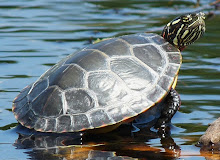
we met a painted turtle who was unusually calm.
She stayed put, even as we talked to her.


Unlike this fellow, who quickly plopped into the depths after I got a little too close. Look at those long front claws, which is a clue that this might be a male.


What a fantastic evening - the water, clouds, the mountain -


and we mere mortals floating on reflections of heaven.


This was just a brief blessing of good weather, with more rain already on its way. So we took our time, knowing it was a gift.
There was even a glimpse of a rainbow. It lasted just a minute or two.
I think that only Rick and I saw it.
How many wonders, large and small, have he and I been witness to!


[from the same Journal entry:]The revelations of nature are infinitely glorious
and cheering,
hinting to us of a remote future,
of possibilities untold;
but startlingly near to us some day we find a fellow-man.

Sunday, April 24, 2011

In What Book


April 7, 2011
Spring Run Trail, Saratoga Springs, NY


It is only when we forget all our learning
that we begin to know.

I do not get nearer by a hair’s breadth to any natural object
so long as I presume that I have an introduction to it from some learned man.
To conceive of it with a total apprehension
I must for the thousandth time approach it as something totally strange.
If you would make acquaintance with the ferns
you must forget your botany.

You must get rid of what is commonly called knowledge of them.
Not a single scientific term or distinction is the least to the purpose,
for you would fain perceive something,
and you must approach the object totally unprejudiced.
You must be aware that
no thing is what you have taken it to be.

HDT’s Journal, Oct 4, 1859

Today’s quotation is full of irony. After all, I have just begun to “make acquaintance,” slowly filling a bookshelf with all sorts of field guides, and trying to learn whatever I can about the things I see in my walks.
It would be nice if I could use the scientific terms instead of saying,
“That pointy thing on the flower.”
(Are there courses in Botany as a Second Language?!)


And I consider it a great pleasure and honor to accompany “learned men”
(and women),
which is what I did today.
I went a-walking with the Thursday Naturalists !


The meeting place was at the fairly new Spring Run Trail.
Jackie introduced me all 'round to these folks, who are energetic and knowledgeable.


Leading the walk was Ruth Schottman, famously wise in the ways of plants – yet as we pointed them out along the trail, she greeted each one with the enthusiasm of someone seeing it for the first time.


She carried a book which was well-worn, but obviously loved.


It was one of those days so rare this spring -- above freezing, and sunny. Despite the snow lining the path, there was plenty to see and marvel at.


 Hazel trees were bursting with tiny pink stars, and alders stood loaded with dangling yellow catkins.

Ah yes, we must determine exactly WHICH type of alders they were.


 Last year’s burdock stood along the brook,


the hooked burrs looking to hitch a ride to anywhere.


This trail is a recent addition to the fine system of local trails in Saratoga County.
Along the way, a reminder of how brooks were once treated.


Nowadays things are different, and abandoned waysides like these are coming to life in a new way.


As if to prove the point, we saw stumps, vigorously sprouting.


Beside a small brook, skunk cabbage was melting the snow with its chemically-created body-heat.


Sheltered inside, one of spring’s first flowers – though it hardly looks (or smells) like one.


One skunk cabbage looked more like an eggplant, squatting there amongst the liverwort.


Which itself is an interesting thing to see, with its lizardy cell structure.


Just as we did when we were nine years old, we played happily in the brook.


By the time we returned to the parking area, the scent of skunk-cabbage was forgotten as we got a whiff of something much more pleasant - the wood-fired grill of a local hot-dog vendor!


We dined al fresco in the warm sunshine.

It was a fine day to be outdoors, to meet some very interesting people, and to see some signs of spring – including coltsfoot, which Jackie described as “the first spring flower to actually LOOK like a flower.”

It's a beautiful sight. A little bit of sunshine at your feet.


I think maybe I understand what Thoreau is saying. Of course, he also started out learning in the traditional way. A Harvard graduate (Class of 1837), he perused ancient Roman texts on the natural cycles of the year, consulted the few field guides that existed back then (Gray's Botany, 1848 edition), gathered specimens for Agassiz (both plant and animal, something he later regretted), and was among the first to read and champion Darwin. Yes, he listened eagerly to the “learned men” of his time.


He also spent many an hour talking with neighbors. He not only participated in the stimulating Conversations at Ralph Waldo Emerson’s home, but also sought the advice of the local old-timers –- farmers, muskrat trappers, Canadian wood-choppers. On his Maine excursions, pummelled his Penobscot guides with questions.


Some of his most treasured books were not science books, but volumes on Hindu and Asian scriptures, gifted to him by a friend. He built a custom-fitted box for these books, using driftwood gathered during his paddles on the Concord River.
As years went on, he didn't care to join organizations, and rather starts to sound a lot more zen in his attitude toward nature. 


Above all he trusted his own direct experience. Throughout his life, he explored that balance point between the poetic and the scientific outlooks. He seems to say here that you can be tilted too much toward one extreme or the other -- that you need to stay open for new experiences, and let the heart lead the way, sometimes.

 
[same Journal entry, continued right where we left off:]
In what book is this world and its beauty described?
Who has plotted the steps toward the discovery of beauty?
You have got to be in a different state from common.
Your greatest success will be simply
to perceive that such things are,
and you will have no communication to make
to the Royal Society.


Wednesday, April 13, 2011

Looking for Mayflowers in April

April 3, 2011
Back Bay, Moreau Lake State Park


In the summer, greenness is cheap,
now it is something comparatively rare,
and is the emblem of life to us.

HDT's Journal October 4, 1859

It was a sunny Sunday, and I could take a nice long walk today.
Time to check on conditions at Moreau Lake.

During the heart of winter, the ice gets to be a foot thick here.
Today – April third - it is still frozen over.
No picnicking or swimming today !


Although it was melting at the edges.


Just as in the beginning of winter, I’m irresistibly drawn
to the meeting-place of ice and water.


To watch the transition from one state of matter to another.

The ice has melted and refrozen in interesting patterns -
did Monet ever paint ice, as well as water-lilies?


Despite the beauty of the ice,
it’s also a joy to see the water moving freely again.


Turns out I’m not the only one attracted to such a place.


There were newts, which evaded the camera, as I peered into the water and cast shadows on their sunny underwater forest of dead leaves.


There were minnows, flirting with the sandy shallows.


They played peekaboo at the small holes in the ice.


While I was watching the minnows, Jackie hailed me. She had come here today too, to see if she could find the trailing arbutus.


It should be budding by now, being one of the earliest flowers of the year.
Another name for it is Mayflower.

Despite extensive snow cover still on the ground today, there were some areas near the back bay that had melted back in recent days.


So that’s where we headed, to a place where we had spotted this plant before.


The past few weeks have been a test of our not-so-abundant patience,
as winter has seemed to linger on and on.

But it seems important, somehow, to be there when things happen.
Even if it's to check on the progress of a shy and retiring plant.


We are grasping for ANYthing green.


And when you find it, it brings you to your knees in gratefulness.


It may look as if she is praying – and indeed there are many forms of prayer.


It’s a relief to know that despite the apparent lateness of certain phenomena on the calendars we keep so faithfully,


Nature is still moving along, although on her on time and schedule.

Wednesday, April 6, 2011

What is a Raven?

March 30, 2011
Warren County Bike Path


Welcome to "Jeopardy" !
Now for 100 dollars, here is the clue: It’s our largest songbird.
(Jeopardy theme music plays here -- doo doo doo doo, etc.)
Time's up ! If you answered “What is a Raven?” – you are correct !

They are indeed, classed as songbirds, so I guess there is hope for all of us.
Around the world, they mean many things to people of different cultures.
To some they are evil, harbingers (or even hasteners) of death.
Being carrion-eaters doesn’t help their reputation. Warriors of old noticed who was first to show up on the battlefield , when the fighting was over.

To others, they are gods, or messengers from the gods. Or messengers TO the gods, like the pair Huginn and Muninn, who sat on Odin’s shoulder and informed him of the doings of mortals far below. (Click on all of the green words, to follow a link.)


Spies. Conspirators. Tattlers. One term for a group of ravens
is “an unkindness.”


They have one of the largest brains, proportionally, of any of the birds. Researchers, like my hero Bernd Heinrich, have collected stories and data which show ravens using wolves and human hunters to locate food for them. They have been observed using tools (the famous meat-on-a-string experiment) , and making toys with sticks, and playing.


Bringers of fire, according to an Abenaki story. In a similar Lenape story, from people who lived just south of the raven’s range , the hero is Rainbow Crow, who like the Raven, burned his beautiful feathers in stealing fire to bring to the People. In the Pacific Northwest cultures, Raven the Trickster steals the Sun itself, and pays a price.


                                                                               ( Haida clan crest )

Usually a nest site is chosen for remoteness, as a protection from predators, both animal and human. Many generations of ravens learned the hard way not to nest too closely to farms and houses. So most nests are found high up on rocky cliffs, far from our eyes and weapons.

In short, we humans have a complicated relationship with these creatures.


I love ravens. When they call, it feels like
they are calling to me.
Lookout ! Lookup !
Who really knows what they are saying? Researchers have identified at least 30 different vocalizations, including a fascinating “gong” noise that sounds just like someone hitting a metal flagpole.


Today I took a short walk at the bike trail nearby, to check on the Frog Puddle. A year ago, the ground was clear of snow, and in this puddle, woodfrogs were gathering. Today, that puddle is still frozen over, so there would be no “qwacking” heard today !


Instead, I heard croaking of another sort, and paused to find the source. Then a hearty Rrrrrwhaaaa! rang out, and I knew it was a raven.
That “crazy-lady scream” is unmistakable. It was coming from some tall white pines, over by an electric substation.


The trail passes close enough to this station for me to see large black birds, swooping around one of the metal pylons. Over the hum of electrical currents from the transformers, I could clearly hear the ravens calling.
Look over here !


And there they were, one raven perched on the farthest pylon, next to a pile of sticks. They seemed to be building a nest, right out there in the open, close to several busy roadways. In the middle of an electrical substation !


So at first I did not believe my eyes. What a rare treat ! And one easily observed with just a pair of binoculars, standing there just yards from the car.

It seemed an odd place. After looking about , I observed that there is plenty of pine woods, water and all the fast-food dumpsters one might wish for, close at hand. (or, wing). No irate farmers standing by with shotguns – just cars going by, the drivers intent on getting bargains at the mall.

The first raven was just hanging out, enjoying the view, perhaps. What shall we have for lunch today? Long John Silver’s, or Golden Corral?


The other raven , cawing as he flew, was coming back from a dead standing pine nearby, and was carrying a twig in his beak. They called loudly to each other. They weren’t being sneaky at all. That was a sharp contrast to crows, whom I have seen building a nest in eerie and uncharacteristic silence.


When the second raven alighted next to the other, some quiet croaking conversation passed between them. Little clucks, urps, chuckles.
A young couple setting up house. They are believed to mate for life.


I wish these two the best of luck.

Monday, April 4, 2011

First Day of Spring

March 21, 2011
Outside my window


The bluebird carries the sky on his back.
Thoreau's Journal, April 3, 1852


Ah ... a leisurely stretch, as the last dreams of the night fade,
and I open my eyes to welcome this morning,
and see … snow.


Pretty little white flakes, drifting down.
Again.
Don’t they know that Winter is officially over?

Well, there are other ways to celebrate the first day of Spring,
besides picking posies. (I’d have to go to a garden center greenhouse, in order to do that !)


It’s a day for a walk, at the very least.
Just to see what’s going on outdoors.
As I pull on my boots, Mom calls me to the window.


A bluebird is sitting just outside.
He’s chirruping softly, but seems confused by the snow.
He hunkers down on a neighbor’s wind-ornament,
which proceeds to slowly spiral around,
with the bird riding on it!
(if you turn up the volume, you can hear very faint chirrups.)


If that bluebird could flap his little wings and fly due east,
and magically fly for many many hours,
he would look down through the clouds
and see some of my Friends celebrating the New Year
on this day.


For the moment, this bird seems to be content
with spinning around,
quite vividly bringing the words of Thoreau to life:


I no sooner step out of the house
than I hear the bluebirds in the air, and far and near, everywhere except in the woods,
throughout the town you may hear them, --
the blue curls of their warblings, --
harbingers of serene and warm weather,
little azure rills of melody trickling here and there
from out of the air,
their short warble trilled in the air reminding me
of so many corkscrews
assaulting and thawing the torpid mass of winter,
assisting the ice and snow to melt
and the streams to flow.

HDT Journal, March 18, 1853