Tuesday, July 7, 2009

A Chestnut By Any Other Name

July 6, 2009

Another fabulously clear and sunny day! What else was there to do but to get that kayak into the water?


Concord is located at the junction of two rivers, the Sudbury and the Assabet, which join together to form the Concord River. Today the Sudbury was my destination, with a trip through Fair Haven Bay. When I was here in October, the wind came up in the afternoon, and the waves form pretty easily on the wide expanse of relatively shallow water.

Today the sky was completely clear and the water smooth as silk. At the put-in, I saw a weird contraption hanging into the water:


It was a harvester of some sort. Then I recalled what I saw here last year, covering almost the whole surface of the Bay:

the Dreaded Water Chestnut


It’s a nasty invasive that, among other things, makes paddling a real pain. It forms a mat that will yank the paddle right out of your hands. And forget about going close to the shoreline. Of course it is much more than an inconvenience for the local flora and fauna.


Fortunately, in Moreau Lake, it has not been spotted yet. It spreads by way of nasty-looking floating seedpods which attach to boat trailers.


Lake George Association has a good educational program at local marinas about this and other aquatic invasives which can travel from state to state this way.

Here in Concord, it is apparently rampant enough to warrant the Department of Public Works here to have a contraption that looks like something out of a Mark Twain nightmare:


When I arrived downstream at the mouth of the bay, there was this vessel, ker-chogging loudly around the edges of the bay, mowing a swath through the thick layer of water chestnut and conveying it into its hold, to be hauled out in a dump truck later.

My vision of a bucolic float through the bay was mowed down just as neatly.

So far this trip was becoming something of a Grim Reality Check. Hey, Sue, welcome to 2009 !

Well, it’s good to know that at least something is being done to try to restore the balance; a balance that, in this case, was upset by humans in the first place.

The machine was on the east side of the bay, so I kept to the left and continued down the placid Sudbury River. There was a rocky point along the western shore (Lee’s Cliff?) (Was this where Henry T. waited out a thunderstorm ashore, under his overturned boat ?)


Saw several blue herons, a green heron, a Canada goose family. The shoreline growth was mostly button bush, and in other places was a lush mix.

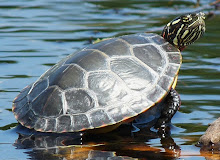
Painted turtles by the dozens ducked back into the water at my approach, sometimes just a swirl in the duckweed the only evidence of them. Pickerel weed was just opening its spikes, and water lilies were everywhere. Clouds were forming in the heat of the day, and that just made the scenery more interesting, as they were mirrored in the smooth surface of the water.

After turning about, I returned along the east shore, under Fair Haven Hill - one of Thoreau’s favorite places to watch sunsets and moonlight on the Bay. Today numerous inobtrusive foot trails traverse the wooded ridge. One path comes steeply down to the river’s edge, and it was here that I pulled ashore to stretch my legs and just admire the view.


The big noisy chestnut-eating machine was gone. The only sounds were the yawp of a heron on the river before me, a thrush song in the woods behind me, and the peculiar lip-smacking noise that seemed to come from the buttonbushes growing at the river’s edge.

Returning, I continued a short way upriver, past the put-in spot. I was getting sunburned, and it was time to call it a day. Turning about – after looking at lilies "just one more time" – I looked up to the north shore and saw a sight that made my jaw drop:


It was a tall chestnut tree, in full bloom! The sight of it took my breath away – this was not supposed to be happening – they were almost extinct in this area! I took lots of photos, and for some time, just sat floating in the boat, gazing at this miraculous sight. The flower spikes covered the tree in white dreadlocks.

After hauling out, still marveling at this good fortune, I took a different road back to the inn. Suddenly I pulled the car over – there, in the dooryard of a very old homestead, was

ANOTHER chestnut tree in full bloom!


Now anyone with half a brain would have figured it out by now, but no, I was just too entranced.

This one was about 40 feet tall, but wide. Gnarled low-hanging branches practically drooped to the ground, festooned with fuzzy white blooms. The ground below this ancient-looking tree was covered with the empty husks of burrs. I got out of the car, camera in hand. As I approached the tree, it seemed to be humming. There were bees and bee-lets of all sorts, on almost every bloom.


There was an indescribable scent in the air, though not as funky as some have described. The leaves seemed very glossy on the topside, paler beneath. And little proto-burrs were already forming.

Weird smell or no, I was as intoxicated as those bees for the whole ride back.
Now, whom could I contact about this incredible sighting? It must be reported!
TWO blooming, blight-resistant chestnut trees – in one day!

Later that evening, I looked at the photos on the laptop. It was time to shift from drunken-bee to sober-scientist mode. Though they were toothed, those leaves did not really have the deep scalloped edge if the American Chestnuts I’ve seen. And they were pretty dark and glossy. Hmm.


Time for the buzzkill. After doing a little internet research, most likely these trees were JAPANESE chestnuts. They are sometimes blight-resistant and had been introduced as an orchard tree in America in the 1870s.

Here’s one interesting link:
http://www.westmorelandconservancy.org/amch/ChestnutComparison.html

Well, it was fun while it lasted. One can only imagine a hillside of magnificent American Chestnut trees in bloom. Maybe we’ll live to see that again.

Monday, July 6, 2009

Expedition to Walden Woods

July 5, 2009

Headed southeast from Rick’s place, past the beautiful West River and Mt. Wantastiquet looming over Brattleboro. Here’s the view of my morning commute, when I lived in Vermont.


My route to Massachusetts angled across New Hampshire on Route 119 – notice the horrendous holiday traffic:


The day was sunny – after several days of rain and storms - and grew warmer as I neared Concord. After arriving at my lodgings, all I wanted to do was to jump into Walden Pond. WELL so much for THAT idea:


The pond and surrounding woods are part of a State Reservation, and are heavily visited on all summer weekends, but this was Fourth of July as well. Walden Pond is only eighteen miles from Boston. The park has a limit of 1000 visitors at a time, and once that limit is reached (approx. 330 cars in the gated parking lot), no more cars are allowed in.

What I didn’t realize (since I was within walking distance, and on foot) was that once that limit is reached, pedestrians were not allowed in either. Had a nice chat with some of the dnr staff who were posted at every pathway leading to the pond. The were friendly but firm. The ones I spoke with told me the closing would only be between 3 and 4 pm; by then enough people would be heading home that it would be OK to walk in again. I also chatted with 3 pretty-steamed bicyclists, who had ridden all the way from Arlington MA, and had been looking forward to a swim in the pond, before heading back.

Well one door closes, another opens, as they say.

I took the opportunity to walk about a half mile toward Concord (crossing the dreaded Route 2), to explore Brister’s Path.


This is a wonderful trail created along a hill that Thoreau used to frequent. His observations here led him to develop an essay on the succession of forest trees, which was a new way of thinking about the environment in the 1850s.


The trail is roughly a loop (with interesting offshoots) and along the way, there are quotations of Thoreau, etched into granite markers which are laid out on the ground at various places. It’s very effective - you are literally walking through his writings.

One area was a circle of curved granite blocks, with quotations about Thoreau and his ideas – by other people who have been inspired by his writings, such as Wendell Berry and Martin Luther King. Then I came upon this quote which I was familiar with, but after being on the trail and seeing it in this setting, I was powerfully moved:

Could a greater miracle take place than for us to look through each other’s eyes for an instant?

For a moment, I was lost in one of those transcendental trances … when I noticed some movement out of the corner of my eye:

The largest garter snake I have ever seen, was apparently also “moved” by this part of the trail. He had been sunning himself in this perfect spot – nice warm granite - when I happened along.

Along this trail were pipsissewa and spotted wintergreen in bloom, Indian pipes arising from the dead by the thousands (they did tell me it has been raining here for two weeks straight!)

and other cool sights:

a katydid:


Butterfly weed:


The walk lasted over an hour; it was time to head back. By 4:30 the pond was no longer “closed” and my task was now to thread through the many folks on the beach, and walk the pondside trail to a swimming spot. The pond has heavy plant growth all along its edges – clethra and other shrubs – and every so often there is a little break in the vegetation, sometimes just two feet wide, down to the water’s edge. There are natural-stone steps allowing you to have a sort of private spot to swim or just sit and look at the pond.

Today it was so crowded, most of those spots were “taken” – I finally found one at the shady far end, steep but uninhabited. The water was cool but oh so welcome.


Saturday, July 4, 2009

Independence Day

July 4, 2009

OK, I'm usually the one to bring up Henry David Thoreau in almost any conversation, (you might as well be warned of my faults up-front) but what, pray tell, is his connection with Independence Day?


From Walden:

When first I took up my abode in the woods, that is, began to spend my nights as well as days there, which, by accident, was on Independence Day, or the Fourth of July, 1845 ….


I went to the woods because I wished to live deliberately,
to front only the essential facts of life,
and see if I could not learn what it had to teach,
and not, when I came to die,
discover that I had not lived.


I did not wish to live what was not life, living is so dear;
nor did I wish to practise resignation, unless it was quite necessary.


I wanted to live deep and suck out all the marrow of life,
to live so sturdily and Spartan-like as to put to rout all that was not life,
to cut a broad swath and shave close,
to drive life into a corner, and reduce it to its lowest terms, and,
if it proved to be mean, why then to get the whole and genuine meanness of it,
and publish its meanness to the world;


or if it were sublime, to know it by experience,
and be able to give a true account of it in my next excursion.

I would not have any one adopt my mode of living on any account;
for, before he has fairly learned it
I may have found out another for myself,
I desire that there may be as many different persons in the world as possible;

but I would have each one be very careful
to find out and pursue his own way,
and not his father's or his mother's or his neighbor's instead.


Fourth-of-July Eve

As I write this, I hear the distant pouf and boom of fireworks not too far from here.
While walking this morning with Jackie, we discussed how many of the flowers we see at this time of year seem to evoke memories of firework displays from days past –

Such as those sort of dull ones in the first part of a fireworks show,
that just went pop pop pop and you said, is that all there is?


Or those little star-like streamers that would drift back to earth going Eeee – eee- eee ?

Or those favorites of the backyard pyromaniac, the Roman candle?

Me, I always preferred just running around the yard with sparklers!

Here's wishing you all a happy Independence Day –
May you find your own unique ways to celebrate the

Red

White

and Blue!

Friday, July 3, 2009

Hello my friends,
Please bear with me as I try to figure out why I cannot reply to your comments - I DO treasure them! I'm blogologically-challenged, it seems. When I figure out how to do more than just post, you will be hearing from me ...

Meanwhile it's time to pack for a weeklong visit to Walden Pond, where Thoreauvians gather annually to spawn - no wait! I mean, to attend fascinating lectures and meet friends from all over the world who admire Henry David Thoreau for one reason or another, and to walk and paddle in his beloved Walden Woods and rivers.

Somewhere in the middle of stuffing clothes, kayak and tent into my car, I will work up a Fourth of July entry to before I leave home.

Thursday, July 2, 2009

Checking on the Chestnuts

(belated entry for June 24, 2009)

(I'm catching up!)

Last September, while paddling with Rick on the section of the Hudson River which flows through Moreau Park, I saw a tree with long, toothed leaves along the shoreline. It was larger than any of the American Chestnut sprouts I have ever seen.


Then I saw the brownish burrs.

Of course I knew what it was, from pictures in an old old tree identification book, though I had never seen one before. Lots of people have never seen one – since the chestnut blight has all but wiped out most of the species. Small trees still arise from stumps, but most never live long enough to flower, or produce nuts.

And there they were, hanging over my head like forbidden fruit.

I read of a naturalist who said, “it’s like looking up and seeing a passenger pigeon flying by.”

I was pretty excited about it that day. Since then, we’ve located more mature trees within Moreau Park. Unfortunately, this flowering can be a sign of a tree in distress – the next year, they may be dead. I am just beginning to learn about these trees, once called “the redwoods of the east.” Many knowledgeable people are working on ways to keep the chestnut from going completely extinct, such as the folks at the
American Chestnut Foundation.

June is the flowering time for chestnuts (so that old old book said,) and Jackie offered to accompany me on a river paddle today. I am pretty much of a weenie on big open water, even a pondy section of river like this. So I appreciated her company. It sure was a nice day to be on the river!


We wanted to see if we could spot any blooms on the trees along the river.
Or if there WERE any trees still alive.

Happily we found several in that stretch of shoreline.

Delicate dreadlocks of flowers.

As you drift downriver, passing under a pageant of green banners - oak, ash, hornbeam and maple -- there's another whole forest scene under the water. Long swaying grasses - something that looked like raccoon-tails - little floating plants with gear-like flowers - and unfortunately, the feathery beautiful (but invasive) Eurasian milfoil.

(Jackie ID'd this later. I thought it looked like peacock feathers.)
We continued downriver to a place very dear to Jackie, a beautiful sheltered cove.

In the winter, I had walked across its frozen surface, on a group hike to watch the wintering bald eagles. It was love at first sight, & I vowed to come back in the summer, to explore it by kayak.
This first watery visit was all too brief. It seemed that as soon as we arrived, it was time to leave. I kept apologizing and saying, "sorry, I really have to head back now..."

But you can be sure that I’m planning another visit soon!
Complain as I will about having to stop and go in to work - at least I am grateful that my schedule allows me to be floating in a quiet cove on a sunny day, at an hour when many people are stuck indoors behind a desk.


Friends in High Places

(belated entry for June 23, 2009)
Today, instead of a solitary walk, I went back up to the Spring Overlook with Jackie. We had planned on getting a hike and a paddle in sometime this week; my limitation was that I would have to be back both days by noontime, since I work in the afternoons. I am jealous of her retirement freedom!
The wind was already brisk by mid-morning, so the paddle was put off for another day.
We saw plenty on the way up to the Overlook, and came back again a slightly different route.

What caught my eye today was how colorful things were.

Off to a flying stop: we started seeing wondrous sights about twenty feet from the trailhead.


Wild basil in delicate bloom
While walking along a ferny easement, hermit thrushes on our left and right played catch with phrases of their flute-like song

Whirled loosestrife, whirling

At what moment does a blossom become a blueberry?

A lilac-colored mushroom.

Despite all the stops, we did eventually get to the ledges, and stopped for lunch. This cafe has a wonderful view, to put it mildly.

Along the ridgetop behind the ledges, we saw boulders and mushrooms and a friendly woodfrog. There were also lots of burned-looking stumps (I found out later that there had been a large fire up there several years ago, caused by humans.)
There was evidence of another possible cause of fire – a lightning tree! A red oak, with a long vertical scar running down to the ground. There were thin strips of wood that had peeled down along the scar. All in all we saw about 4 or 5 trees in that condition, all oaks. I could not help but look upward nervously, despite the clear skies above.

Maybe my instincts were right, two days ago, when that storm cloud swept over & I scurried to a lower elevation.